
Epic Refuel Checklist
Is Your Team Ready for the Deep Dive?
For many health systems, an Epic Refuel is the moment when a routine optimization effort turns into something much more valuable. It is a structured opportunity to step back, evaluate how your organization is truly using Epic, and identify where workflows, governance, and system configuration can improve performance.
Organizations that approach a Refuel strategically tend to uncover meaningful improvements in clinician efficiency, revenue cycle performance, and patient experience. Those that do not prepare often spend valuable time gathering information that could have been ready on day one.
If your organization is planning an Epic Refuel, the question is simple: Is your team ready for the deep dive?
Below is a practical checklist to help ensure you are prepared before the engagement begins.
Start with the Right Data
A Refuel is fundamentally a data-driven exercise. Epic’s team will analyze how your system is being used today and where opportunities for optimization exist.
The more organized your data is ahead of time, the faster the review can move from discovery to actionable recommendations.
Before your Refuel begins, make sure your team has access to:
• Recent usage metrics and analytics reports
• Signal reports or Epic benchmarking data
• Provider efficiency metrics
• Revenue cycle performance indicators
• Known pain points reported by clinicians and operational leaders
Having these insights readily available allows the Refuel team to focus on solutions rather than data gathering.
It also helps your organization validate whether perceived issues align with the actual system data.
Align Your Internal Stakeholders
Epic Refuels are most effective when the right voices are involved early. A Refuel is not simply an IT exercise. It touches clinical operations, revenue cycle, governance, and sometimes executive leadership.
Before the engagement begins, identify the stakeholders who will need to participate in the process.
This often includes representatives from:
• Clinical leadership
• IT and Epic application teams
• Revenue cycle operations
• Informatics or analytics teams
• Executive sponsors responsible for strategic initiatives
Clear ownership and participation ensure recommendations can move forward quickly once they are identified.
Without alignment, organizations risk discovering opportunities that stall because decision-makers were not engaged during the process.
Clarify Your Organizational Priorities
Every health system has different goals when approaching a Refuel. Some are focused on reducing clinician burnout. Others want to improve patient throughput, optimize revenue cycle workflows, or prepare for a major expansion of services.
Taking time to clarify these priorities helps guide Epic’s analysis toward the areas that matter most to your organization.
Consider discussing questions such as:
• What operational challenges are we trying to solve?
• Where are clinicians experiencing the most friction in workflows?
• Which areas of Epic have not been reviewed since initial implementation?
• What strategic initiatives should Epic optimization support over the next 12 to 24 months?
When priorities are clearly defined, a Refuel becomes a strategic planning exercise rather than a general system review.
Review Governance and Decision Processes
Refuels often uncover a long list of improvement opportunities. The challenge is not identifying them. The challenge is implementing them.
Before the Refuel begins, it helps to evaluate how decisions about Epic changes are made inside your organization.
Ask yourself:
• Do we have clear governance for prioritizing Epic improvements?
• Who approves configuration changes?
• How quickly can cross-departmental decisions be made?
• Is there a process for evaluating requests from clinicians?
Strong governance allows your team to act on Refuel recommendations quickly and maintain momentum after the engagement ends.
Set Realistic Timelines for Follow-Through
One common misconception about Epic Refuels is that the work ends when the review is complete. In reality, the Refuel is often the starting point for a series of optimization initiatives.
Organizations should be prepared to allocate time and resources to implement the recommendations that emerge.
This may include:
• Workflow redesign
• Configuration changes
• Training updates for clinicians
• Additional reporting and analytics development
Planning for follow-through ensures the Refuel delivers lasting impact rather than a list of ideas that never reach execution.
Preparation Drives Better Outcomes
Epic Refuels can be incredibly valuable when approached with the right preparation and organizational alignment.
By organizing your data, aligning stakeholders, clarifying priorities, reviewing governance, and planning for implementation, your team can maximize the value of the engagement and accelerate meaningful improvements across your Epic environment.
Preparation turns the Refuel from a review exercise into a catalyst for operational progress.
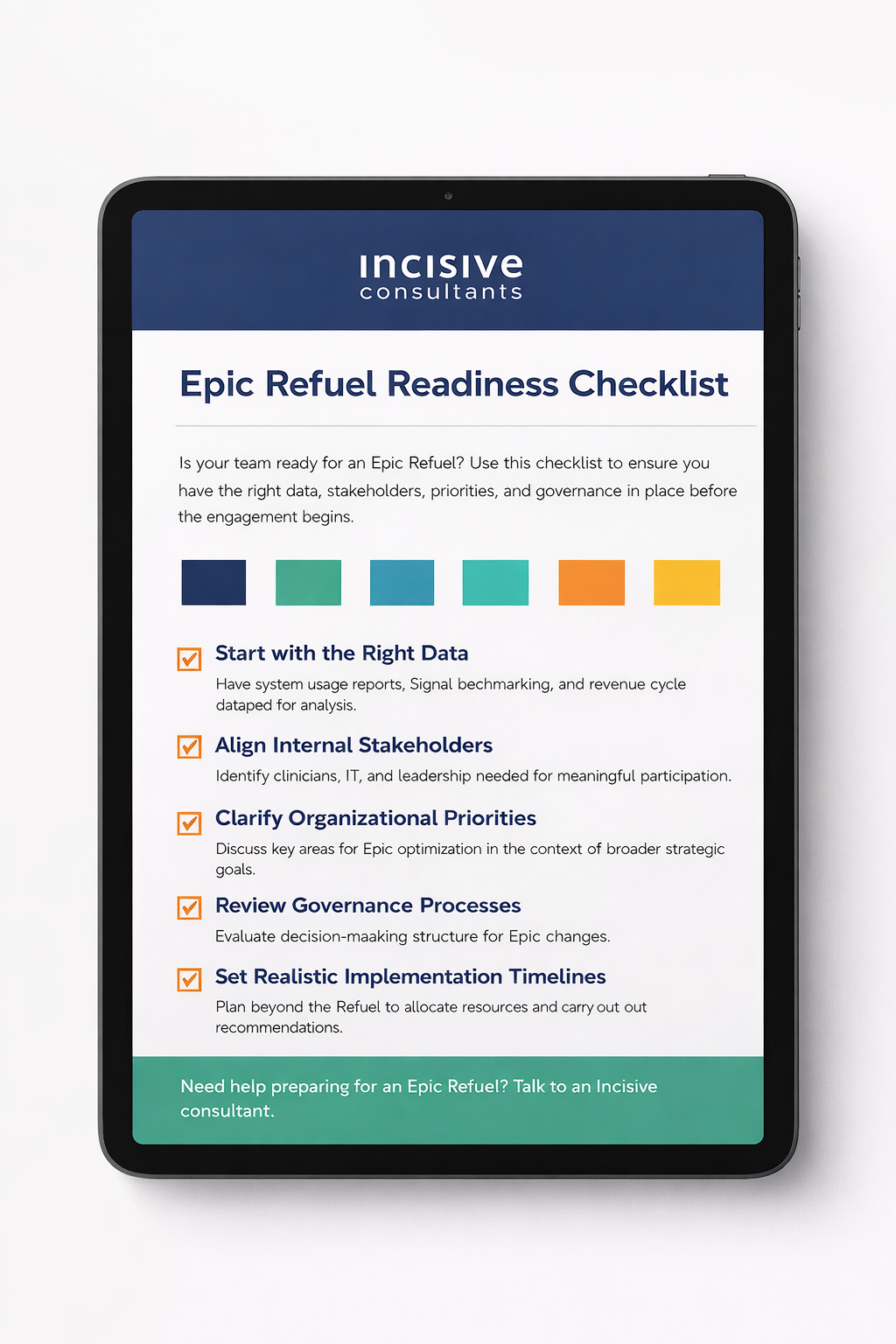
To help your team prepare, we have created a downloadable Epic Refuel Readiness Checklist that summarizes the key steps outlined above.
Use it to ensure your organization has the data, stakeholders, and processes in place before starting your next Refuel engagement.